For a period of time in middle school, I wore a forest green woven bracelet that read, “GO THE DISTANCE” in white stitching. They were handed out at a Christian sports camp I attended summers before. When it came to sports, I preferred being a spectator. Attending camp challenged me to try something new. Over several summers, I learned that I preferred individual sports like tennis and cross-country to team sports, like soccer. I never considered myself much of an athlete, but the bracelet gave me a small sense of belief that I had it in me.
I’ve turned those three words, “Go the distance,” over in my mind countless times since then. They lift me when I want to give up. They apply to weary seasons I find myself in, to finish strong. They remind me that life is a series of decisions. And all my decisions write the stories that make up my life.
Leadership is a long game. It’s navigating through circumstances with people. And it’s a series of decisions. Decisions that tell a story about what we value. Decisions that affect the future. Decisions that either unify our words with our actions, or divide them.
Some day, people will tell stories about my leadership. My kids will tell stories about my parenting. My co-workers will share what it was like to be on the other side of me in meetings. My resumé will have two dates between a dash. I can only guess at the stories they’ll tell, but I hope they say I was the type of leader who could go the distance.
I hope people will sense that I applied myself to every situation. That I gave my best and that I saw the best. Especially when I was tired and overspent. I hope they say I was a leader who lasted. Who weathered storms. Who built character during high tide and kept others from coasting during low tide.
I’ve got miles to go. And in this chapter, I’m trying to walk alongside experienced leaders who have something to teach me. So here is what has been illuminated for me lately.
2) Leaders listen to learn.
One of the benefits of working remotely is that I’ve been forced to pay closer attention to the nonverbal aspects of communication. Tone can hint at someone’s mood. Pitch can reveal stress. Pauses between speaking can signal thoughtfulness, confusion, or ideation. Nonverbals may suggest things to me, but asking questions helps me find out if they’re accurate. Sometimes I’m wrong, and read into things. But more often than not, people reveal themselves through what they don’t say out loud.
If there’s any skill I hope to develop deeper over my lifetime, it’s listening. I think I will always be a student in that sense. I’m discovering the wisest leaders share this sentiment. I’ve been on the other end of the line many times to know when someone is distracted or when someone is really interested. I’ve answered work FaceTime calls and have legitmately watched a person swipe mascara on their eyes, using the camera as their mirror. Not being listened to, feels a certain way. And I too, have been an inattentive listener many times.
I’ve cared more about what I want to say next. I’ve readied my comebacks, thought about what I’m making for dinner, texted someone else, all while acting like I’m listening. But what I’m learning is, 1) people can always tell if you care about what they’re saying and 2) leaders are motivated to listen because they believe there’s always something to learn.
Seasoned leaders often talk about who they were in the first half of their leadership compared to wiser versions of themselves in their second halves. When I listen to their stories, a common theme throughout is that they realized there was more power in listening than there was in having the last word.
I’m long winded. I can talk in circles and rack up minutes doing it. But when I get really intentional, and posture thoughtful questions towards others, my days get really exciting. In listening to one leader talk about their struggle to get organized, I realized I had heard another leader share the same difficulty. Dots connected as I listened. A solution became clear. We implemented it the same day. The tiniest of weights lifted for all of us. And we got to move forward a little lighter.
Other times when I’ve practiced listening, solutions don’t come dancing to the foreground like we hope. Sometimes, no matter their effort, life is still challenging. In those moments, relatability is all I can offer. “I’ve been there, too. It’s hard.” helps people alleviate more leadership pain than I ever thought. Leaders often come back later and say, “Thank you for making me feel like I’m not crazy.”
Reflecting on my growth over the past year, I still battle my insecurity. A lot of that is worrying that I’m the only one who feels a certain way. Listening so I can learn from someone else has shown me, I’m not crazy either. What I thought would erode my credibility with leaders, has been the very thing that connects us.
If a leader can listen with the intent to learn, they’ll always learn. That’s the gift of having agency. I am learning that leaders find solutions for themselves faster when you give them permission to name reality first. “You’re not crazy. That’s valid.” has been the most helpful thing I can say. It’s been an onramp to building trust.
Listening to learn builds trust. Trust builds secure leaders. Confident leaders are solution-oriented. Solution-oriented leaders go the distance.
The world needs stronger leaders and better listeners. Why not be both?
The first time I saw him was a brisk afternoon in March, and I was eighteen. I cautiously drove my first car down the long gravel driveway that led to his grandparents’ house, which had been left to his family after they’d gone. I spotted him through the trees, overlooking the pond, the family dog Baxter at his heel. He was tall and slender in athletic pants, with teenage hair that waved under the rim of his gray hat.
Three months before, I had innocently added him on Facebook, the grandson of church members I’d grown up knowing. When I realized he probably didn’t remember me from so long ago—moving away so young—I messaged him to explain who I was, something I had never done to a virtual stranger. To my surprise, he was moving back to my hometown after graduation before heading off to college like me. It was 2011, and we found a way to keep our conversation going for weeks.
That day in March when he visited, the sun overhead contradicted the wind and cool temperatures, and we drove around town in my gold Dodge Cirrus. His legs stretched out in my passenger seat as I pulled into the park he had gone to as a kid. We laughed as we swung on the swings until our noses ran and bantered easily, just like we’d done online for hours.
By summer, we swore to people we were just friends, but we both knew better. He fell harder first; I was learning to forgive myself after being deeply hurt, the only way hopeful sixteen-year-old girls can be by lost boys. Where I was cautious, Hunter was carefree. The way I felt the weight of the world, he pursued levity and adventure. We thought similarly about what we wanted for our lives, and so different all at once. Learning how to love each other was like getting on a roller coaster: the choice to take a slow incline to the top before the sensation of free-falling around unexpected curves.
When the leaves began to turn, I went off to college with the utmost resolve. Hunter Price was it for me. No one could talk me out of forever and with pure hearts, they tried. I felt so confident in him and yet unsure of myself. I had questions in the back of my mind that would creep in, wondering if I could really be a good wife, if all the worst parts of me would disappoint him. Some days, I wondered if he could handle me, if we were ready for something so serious, if together we had what it would take. My judgment had been wrong before, and that had cost me.
What I did know, what I would bet my life on, though, was that if I were to go through the most devastating things life could throw at me: health crisis, bankruptcy, infertility, loss of a loved one, career failure, betrayal—I somehow knew without a single shred of doubt, Hunter was the person to go through any of that heartbreak with. He is the comic relief to my seriousness. He brings curiosity and possibility when I’m stuck in my ways. He dreams bigger than my meticulous, small-minded plans and helps me dream bigger, too. He is always on time, always ready in unforeseen circumstances, even though he thinks he’s not, always forgiving.
Four years later, on a cold November Saturday, as the last of the autumn trees faded in color, I said “I do” to a lifetime with him. I still had questions about my capacity to unconditionally love someone, but at 22, I felt invincible, like we could figure all of this out. That was ten years ago. And since that day, marriage has humbled me more than I’ve wanted it to in the last decade. Adulthood and hardships have shocked me, and yet, being married has also brought the most adventure to my days.
We moved away from our families to an idyllic town between Madison in Milwaukee the summer after our wedding and thought we were on top of the world. It didn’t take long after changing my last name for me to see the severity of my selfishness, like my inability to see his needs before my own. Making decisions together took longer and unearthed things we didn’t understand about each other yet. Small things like dresser drawers being left open and bed sheets needing to be untucked caught me and my expectations off guard. Seeing him land the coaching job of a lifetime and connect with his players outside the locker room was a surprise in the best way.
Taking on each other’s burdens was messy and uncoordinated. I grew up with a family that never put off transparent conversations; he had grandfathers who were war veterans and dealt with emotions privately, if even at all. I didn’t know how to draw things out of him, and he couldn’t keep me from having an unspoken thought. Handling money together and first-time jobs in an unfamiliar state reinforced our teamwork and revealed our deepest insecurities.
We bought kayaks on a crazy whim and floated along hidden canals to escape the stress of being 23 and inexperienced adults. Instead of taking exotic vacations like our peers, we lived frugally and soaked up the Wisconsin summer sun on Saturdays to feel like we were 18 again. With the latest Luke Bryan hit in the background, I paddled next to Hunter on Lac La Belle. We would laugh about something we watched on Impractical Jokers, and I knew all at once that he had me and I had him. It’s a memory I chase in my mind again and again. We couldn’t make the world stop, but on those Saturdays, for just a few hours, I thought we might.
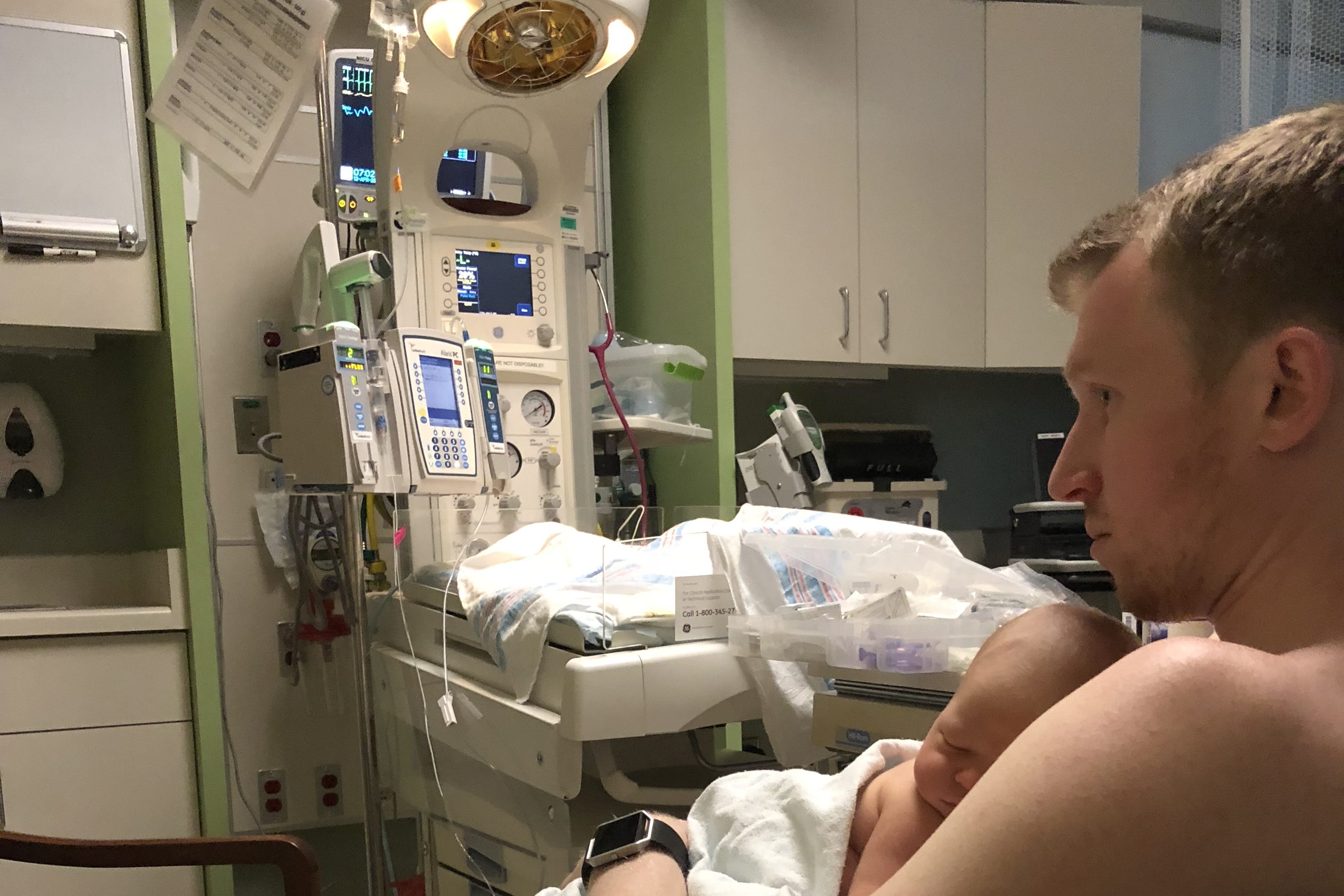
A year later, on a Sunday in August, we learned we were going to be parents by Spring. Griffin was born on a snowy Wednesday night in April. We were euphoric; he was perfect to us at 9 pounds, 5 ounces. By Thursday night, he was admitted to the NICU for tachypnea, and I was terrified. In an instant, every hope we had for celebrating the birth of our first child evaporated. My eyes brimmed with tears for days, not knowing what emotion to feel first as I watched our son hooked up to so many things. It felt like I couldn’t steady my breath every time they pricked his little feet and he cried in surprised pain. I felt a protective anger like I had never felt, so beside myself.
In the NICU bay, with my hand on Griffin’s little bundled body, glowing under the blue light, I remembered my resolve. If I had to go through the worst things in life, I needed Hunter to be what I couldn’t be. And he was. The nurse practitioner spoke a different language I didn’t understand. The nurses changed shifts every 12 hours and I couldn’t tell them apart. We were told one thing and raised our hopes, only to be told something else and crushed by disappointment.
We overheard hospital staff talk about our son like what he was going through was good for their business. Groups of nurses observed every feeding, touching me, a very modest person, without asking. When I was battling both shock and hysteria, Hunter asked the medical staff the questions I couldn’t think to ask. He was calm and steady. He kept me from saying things I’d regret. He was outwardly hopeful when we were both inwardly fearful that we wouldn’t bring our son home.
When we left the hospital with Griffin four days later in the middle of a blizzard, it was Hunter who made sure we didn’t take parenthood for granted. Where I focused on the traumatic experience I never asked for, he fixated on making memories with Griffin, even as a newborn. Because of how tight money was, I didn’t take the unpaid maternity leave I should have taken to heal mentally. A week after he was born, I sat next to baby Griff while he did his light therapy and resumed my work. I felt like I had no choice. But mostly, I was afraid of being irrelevant in my job if they noticed I was gone.
Over the course of the next twelve months, I walked countless miles. I pushed the stroller and pushed through agonizing, conflicting emotions. Living four hours away made it hard for our working parents to visit as often as I needed them to, and daycare was too expensive. I didn’t want daycare. I wanted the freedom to choose whether or not to stay home, but like marriage, I was afraid I really didn’t have what it would take to be a good mother.
I can see now how much I took that out on Hunter. How much I resented stay-at-home moms then. How I resented my job but knew if I didn’t have it, we wouldn’t have groceries. I did the budget so many times, trying to see if the outcome would be different. I became angry that two college graduates, who worked very hard to become debt-free by 24, couldn’t afford a home, let alone a nursery for their child, while other couples could. I thought about all of this while I stared at our apartment walls, waiting for Hunter to come home to relieve me from my overwhelming day with Griffin.
He wanted to be fed every two hours till he was nearly eight months old. The doctor told me I needed to memorize his breathing patterns and stay diligent. Between that anxiety and his round-the-clock feedings, I didn’t know what sleep was. He cried so much, I was convinced he had colic, only to be told he didn’t. I had so much guilt for working. I had guilt for not enjoying my time with him when I wasn’t working. I felt guilty for not working when I took breaks. I ignored every signal my body gave me to slow down and process all of the change. And my marriage paid for it.
By 2020, we had moved away from that perfect town for Hunter’s new coaching job an hour south, and I was reluctant about it. My boss let me keep my job, which had become mostly remote, and we had our second son, Nolan, two weeks before the entire world shut down. Two boys under two, living in a second-story apartment, in a new town, with no friends during a global pandemic, was the hardest season of our married life.
Our lows during those two years of chaos and uncertainty were dark and cold. It became harder for me to make it to Hunter’s varsity games, knowing the kids had bedtimes, and I didn’t need a mask to feel suffocated by all of the responsibility. We were both battling anxiety and frustration when we bought our first house, thinking that would solve so many of our close-quartered problems. It magnified them with a mortgage. Hunter was gone so much on top of a thirty-minute commute, and I stored up grudges at the world as I raked 40 bags of leaves during unpredictable nap times.
Long gone were the days of kayaks, iced coffee, and watching College Gameday in bed after sleeping in. I didn’t recognize who I was. I fixated on what felt like constant fighting, our vicious cycle of negativity and scorekeeping, my resentment, and challenging children when everyone else seemed to have life easier. The miracle of it all was that I kept up with my Bible reading every day and started journaling more than I had before. Page after page, I talked to God, and each day he answered me back with opportunities to practice surrendering every moment to him.
On a Sunday in January, I was outside shoveling snow when I heard blood-curdling screaming inside. It was so loud, neighbors came outside to see what was happening. Nolan, at 11 months old, had crawled all the way across the house and pulled open the basement door I had left ajar. I hadn’t thought to put a baby gate up since we had recently moved and the door was always shut, but if I had he wouldn’t have fallen down thirteen steps onto a bare concrete floor. Hunter made it in time to see it happen, but too late to stop it. Before I knew it, we were racing to the ER on unshoveled highways.
Again, I was with Hunter in a hospital room with our son, terrified, yet steadied by his presence. Nolan’s CT scan came back clear, but he lost the only baby teeth he had at the time on impact. It was Hunter who called the emergency line for the pediatric dentist. It was Hunter who held Nolan and talked his little mind through everything while the weight of the guilt and the grief pressed on my lungs. I was 18 again, reminded that I chose life with Hunter, come hell or high water.
Nolan was going to be okay and so were we. By 2022, we were more settled in our routine with the basketball season and our roles as working parents. That season, Hunter took the Big Foot Chiefs on the longest playoff run in school history and was honored that fall in the Wisconsin Dells for coaching Division 3 Boys Basketball. I started to feel like I was making progress in my job and began practicing gratitude in more meaningful ways than I had before. The cloud that felt like it was over us for several years began to lift.
Time has a way of showing me all of the ways God was weaving a grander story that I couldn’t see when I was so up close. Hunter and I spent this last week in Tennessee reflecting on the past ten years together. It can be hard for me to reflect on the kind of wife I was in my twenties, so focused on my own expectations. It’s also difficult to give myself grace for the times I did the best I could to love Hunter well with what I had at the time. But what I see now in those first seven years is how we were being fortified together. Tested, refined, yielding to the Holy Spirit without the other one knowing.
Since that season, we have moved back to our family in our hometown. I’ve made it through grad school, and Hunter changed his career. He’s home so much more and the best father to our sons in every way. We get to go on dates, and I don’t have papers due anymore. The Lord has worked on my heart to see that the vocational work he has for me is a calling and an opportunity, and I’m having the most fun in my job I’ve ever had. The days are long, but the blessings that come from contributing to kingdom work both at my computer and raising my kids, I never saw coming.
Everything I daydreamed about when I sat on a cold basement floor trying to work while my toddlers played is my life now. Maybe it’s because we know what hard looks like, raising kids without family around. Maybe it’s because we’re wiser and appreciate the small things so much more. Maybe prayer and fighting for your marriage in a quitting culture produce the kind of gratitude that makes life richer for us. But every day when I drive back home and see Hunter’s car in the driveway, I smile knowing I was right.
Whatever I face in life, what I’ve walked through, what I’m still processing, what is yet to come: Hunter Price is the person I want to do this life with, every time.
Saying yes to forever with someone else, so much my opposite, has been like a roller coaster in every way. It’s not what I expected, but it has been more. I’ve been anchored by the decision I made nearly fifteen years ago at eighteen. And I’m so grateful my stubborn, fixed-mindset back then was good for one thing–the best thing.
To Hunter,
Thank you for ten years of patience and resilience. Thank you for breaking through tough conversations with laughter and levity. Thank you for driving, for asking questions, for thinking of how you can support me when you have so much on your to-do list, too. Thank you for wearing Tennessee Orange and not interrupting my ten-minute rants about fictional characters you can’t even remember the names of. Thank you for being so intentional with our boys and for being the calming presence at the dinner table.
Most of all, thank you for being everything I’m not, but making me believe I can be. Knowing you has been one of the greatest privileges of my life. Seeing your personality show up in our kids is one of my favorite joys. If this has been the first ten years, I’m so thankful to have you for the next fifty.
I don’t sing as often as I used to. But growing up as a Nelsen kid, there was singing all of the time. We had guitars and a piano at home for accompaniment, but when I close my eyes to remember, I only hear things acappela. I loved to sing. I’d sing so loud and at such length, my parents would gently try to ask me to sing quieter or give me permission to close the door so I wouldn’t disrupt their work.
My mom still sings in the church choir, and I’d hear her practice each week. My brother played and sang in the youth group worship band, and so did I. When my grandparents, aunts, uncles, and cousins came over for celebrations, we had an unspoken tendency to hold hands in a circle and sing the Doxology, harmonies and all before eating. Every Who down in Who-ville had nothing on us.
I’d hear my grandparents sing or hum as I played with toys in their living room. My grandpa had this way of saying words that sounded more like he was singing them, particularly when he used the word “anyway” to transition the conversation. Music in every facet had meaning to our family. But the person I loved to sing with the most was my dad.
Every so often, he’d play his guitar and we’d sing Scripture he had set to music. Sometimes we’d sing together at church. He would often tell me how much he enjoyed hearing me sing. Dad would sing silly songs too at home. When my brothers and I were young, he wrote each of us a song. Jer’s song was upbeat. “It’s a Jeremy, it’s a Jeremy, it’s a Jeremy Taylor day!”
The first lines of the song he wrote for me ended on a low note and said, “I’m Natalie, I’m Natalie. I love my mom and dad. I’m Natalie, I’m Natalie, and sometimes I get sad.” Dad would always joke with me not to trip over my lip.
The truth was, I had Eeyore tendencies even at a young age. I was strong-willed and felt things deeply, emphasizing the lows of my day at the family dinner table. By high school, victimhood was part of my defense mechanism. On par, I denied it if people tried to tell me that. At the same time I was using deflection, I believed I was always the problem. If I could just try harder or be less needy. If I could be what people wanted, but also be different than everyone else, then the life I was living would have meaning.
Control was my master. I was chasing contradictions built on the shaky foundation of my self-belief. And somewhere along the way of unhealthy thinking, I didn’t sing as loud or as often as I once did.
It made for a confusing internal world. I had knowledge of all the “right” things, but I longed for the kind of wisdom that helps a person live differently. I’d always enjoyed books, but once I entered adulthood, I consumed more literature than my own humanity could sustain. That, too, became a measure of how impressive or interesting I could be. If I read or listened to 300 books in one year, I hit 400 the following year. I thought having this amount of information would ensure I’d never run out of opportunities for connection. My focus derived from a strong need to control my own narrative, rather than accept God’s invitation to participate in his narrative for me.
I read more slowly now. I read books through a second time. I realize that no amount of information consumption can change me when I don’t take my thoughts captive. There are so many that invade my mind. I’m critical of my appearance six ways to Sunday, my overreactive parenting, my chronic indecision, the chaotic responses I give to other people when I feel defensive (which is too often), and all the downsides I see to being on the other side of a relationship with me. Much of my daily energy goes towards image management, wondering what I look like to other people, overanalyzing conversations, and planning for scenarios that only live in my head.
Each morning, I wake up to this kind of unhelpful, overstimulating mental noise. Slowing down has certainly helped my racing thoughts. Writing things out, processing through what is true according to God’s Word and what is my own embellishment. It’s messy and challenging. I lose my temper with my kids and feel shame for that often. I know all the right things. And yet out of the overflow of my heart, I act and think in a way that opposes truth frequently. When I think I’ve reached the end of myself, I find that there’s more I haven’t worked out with the Lord. In some ways, I wonder if that’s just life on this side of heaven or another generous invitation from Jesus to give him all my burdens.
Every fall, I pray over what my word of the year should be come January. Last October, I sensed I was so broken I needed two words for the first time in a decade of picking a word for the year. So for 2025, I chose sound mind. I had heard a song by Kory Miller earlier in 2024 by the same name. Its lyrics would surface in moments of negative thinking, during frustration and impatience.
Over this past year, I’ve been discovering what pursuing a sound mind looks like after years of learning what it doesn’t. I started running again last November, and I found myself replaying Kory’s song again and again as I put one foot in front of the other. I played it in the car. In the kitchen. Without realizing it, I was playing it in my mind. And I started to sing along. It brought out something childlike in me to sing,
“Now every lie is broken because of the words You’ve spoken. I trust the way You made me. I was made for You.”
This is the slow path to renewal. And Jesus, in his steadfastness, has been meeting me on the road. In my sadness over things I don’t want to process. In my emotional tension, when I’m picking things about myself apart. In my dissatisfaction with my perceived lack of spiritual progress.
When I feel my mind spinning, I hear him whisper, “sound mind.” After I raise my voice at home after promising myself I wouldn’t, and my stress levels have risen, “sound mind” comes to mind, and I see a better way. As I start panicking with all the things I have to do, I think “sound mind” and start making a list. There are times I can still know that Jesus has given me the gift of a sound mind, and still, I turn him away. But the frequency with which I choose to say yes is strengthening.
2 Timothy 1:7 “For God has not given us a spirit of fear, but of power and of love and of a sound mind.”
I’m Natalie. I’m Natalie, and sometimes I get sad. Often, I lack godly self-control. Sometimes I make things way more about what I feel rather than the people I love. But I can still sing my way through it. I can rise up against the disorder in my mind with a song. I can try to find the small child I once was, who sang about Jesus in grocery store aisles, confident that Jesus makes me a new person in Him. Because:
“You give a spirit of praise for the heaviness. Gave us a song to raise in the midst of it. I’ve got a sound mind.”
May you and I choose to sing when we don’t know what else to do. When we sense ourselves fighting to control our story outside of God’s love. May we sing when we feel certain and ask for the words to echo when we don’t. In this, may we sense His nearness through the steadying gift of a sound mind.






 The Steadfast Heart